
Euclid facts for kids
Quick facts for kids
Euclid
|
|
|---|---|
| Εὐκλείδης | |

Euclid by Jusepe de Ribera, c. 1630–1635
|
|
| Years active | fl. 300 BC |
| Known for |
Various concepts
|
| Scientific career | |
| Fields | Mathematics (Geometry) |
Euclid (c. 300 BC) was a famous mathematician from Ancient Greece. He is often called the "father of geometry." Euclid is best known for writing a set of books called the Elements. This work explained the rules of geometry and was used as the main textbook for teaching mathematics for over 2,000 years.
Euclid lived in Alexandria, Egypt, during the time of the Ptolemaic Kingdom. He worked with other scholars to study shapes, numbers, and logic. His ideas formed the basis of what we now call Euclidean geometry.
Contents
Biography of Euclid
Life in Ancient Alexandria

Historians do not know exactly when Euclid was born or when he died. Most of what we know comes from writers who lived centuries later, like Proclus and Pappus of Alexandria. Euclid lived around 300 BC, which was after the time of the philosopher Plato and before the mathematician Archimedes.
Euclid spent most of his adult life in Alexandria, a large and important city in Egypt founded by Alexander the Great. Alexandria was a center of learning and culture. It had a famous library and a place called the Musaeum, where scholars gathered to study and teach. It is believed that Euclid set up a school for mathematics there.
There is a famous story about Euclid and King Ptolemy I Soter. The King asked if there was a shorter or easier way to learn geometry than reading Euclid's long books. Euclid replied, "There is no royal road to geometry." This meant that even a king must work hard to learn mathematics.
Confusion with Other Euclids
For a long time, people in the Middle Ages confused the mathematician Euclid with a philosopher named Euclid of Megara, who lived around the same time. Because of this mistake, early books sometimes had the wrong pictures or facts about his life. Today, historians are careful to call him "Euclid of Alexandria" to avoid confusion.
The Elements: A Guide to Geometry

Euclid's most famous work is the Elements. It is a collection of 13 books that organize mathematical knowledge. Before Euclid, many Greeks had studied math, but Euclid collected all the important rules and proofs into one logical system.
Basic Rules and Axioms
In the Elements, Euclid started with simple ideas that everyone could agree on. He called these "definitions," "postulates," and "common notions." Today, we often call them axioms.
Some of his famous rules include:
- You can draw a straight line from any point to any other point.
- All right angles (90-degree angles) are equal to each other.
- Things that are equal to the same thing are also equal to one another.
From these simple starting points, Euclid used logic to prove complex ideas, called theorems. This method of starting with basic truths and using logic to find new truths is still how mathematicians work today.
What is Inside the Books?
The 13 books of the Elements cover different topics:
- Books 1–6: These books talk about plane geometry. This includes shapes on a flat surface, like triangles, squares, and parallelograms. It includes the famous Pythagorean theorem, which explains the relationship between the sides of a right triangle.
- Books 7–10: These books explore number theory. Euclid explains prime numbers (numbers that can only be divided by 1 and themselves) and how to find the greatest common divisor of two numbers. He proved that there are infinitely many prime numbers.
- Books 11–13: The final books discuss solid geometry. This involves 3D shapes like cubes, pyramids, and spheres.

Other Mathematical Writings

Euclid wrote other books besides the Elements, although some have been lost over time.
- Optics: This book is about how we see things. Euclid used geometry to explain how light travels in straight lines and how objects look different depending on how far away they are. It was an early study of perspective.
- Data: This text looks at how solving geometry problems works when you are given certain information to start with.
- Phaenomena: This work discusses spherical astronomy, which is the geometry of objects moving in the sky, like stars.
Some works attributed to Euclid, like a book on mirrors called Catoptrics, might have been written by someone else.
Euclid's Legacy and Impact

Euclid is one of the most influential people in the history of mathematics. For centuries, the Elements was the second most printed book in the Western world, after the Bible.
- Education: Schools used his book to teach logic and reasoning. Even famous leaders like Abraham Lincoln studied Euclid to learn how to think clearly.
- Modern Math: In the 19th century, mathematicians discovered that there are other kinds of geometry where Euclid's rules don't always apply. They called Euclid's system "Euclidean geometry" and the new systems "Non-Euclidean geometry." However, Euclid's geometry is still the one we use in everyday life and learn in school.
- Space: The European Space Agency named a spacecraft "Euclid" to honor him. There is also a crater on the Moon named after him.
Images for kids
-
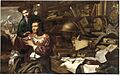
A painting from the 1650s showing the philosopher Euclid of Megara. For a long time, people confused him with Euclid the mathematician.

See also
 In Spanish: Euclides para niños
